
Blockchain Explained: Understand in 5 Minutes Why It’s Changing Banking
You send money abroad.
Digitally. In seconds.
And yet the transfer still takes days.
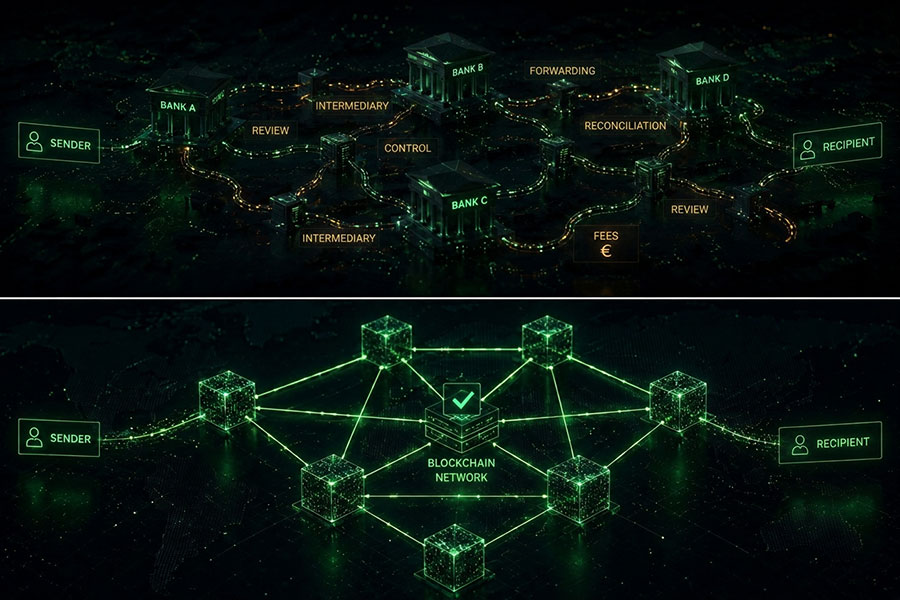
Everything feels modern, fast and connected. You click “Send” — and then… nothing happens. A day passes, maybe two. Somewhere in the background, banks verify data, systems reconcile transactions and intermediaries process the transfer. In the end, your money arrives later than expected — often with additional fees deducted along the way.
So why is something so digital still so complicated?
The real problem: Trust is expensive
The answer lies at the core of our financial system: trust. But not trust between you and the recipient — trust between institutions. Banks trust other banks, systems verify other systems, and multiple intermediaries sit in between. Every single one ensures that transactions are processed correctly — and every one of them takes a share.
That’s why the current system is secure, but often slow, expensive and difficult to understand.
The idea behind blockchain — explained simply
Now imagine a different approach: a shared digital ledger that isn’t controlled by a single bank, but accessed by many participants at the same time. Every transaction is transparently recorded and can be verified by everyone involved. Changes are permanently stored and extremely difficult to manipulate afterward.
That is the basic idea behind blockchain. You can think of it as an open system where everyone works from the same source of truth.
Why blockchain changes so much
The key difference is this: trust no longer depends entirely on centralized intermediaries — it is built into the structure of the technology itself. Every transaction is documented, every change remains traceable.
What previously required multiple institutions can now happen far more directly, quickly and efficiently.
And this is where the real transformation begins. When fewer intermediaries are involved, transfers can happen in seconds instead of days. Costs decrease, processes become more transparent, and users maintain full visibility over transactions.
More than just Bitcoin
When people hear “blockchain,” many immediately think of Bitcoin. But that’s only part of the story. The real strength of blockchain becomes visible when it connects with real-world applications.
A strong example is the energy sector. Today, electricity is produced, consumed and billed — yet for most people, those processes remain invisible. With blockchain, every generated kilowatt-hour can be digitally recorded, transparently documented and directly assigned.
Energy becomes more measurable, more transparent — and eventually easier to trade.
Real-world application: Smart Energy Chain
These ideas are already being implemented in real projects today. One example is the Smart Energy Chain by Smart Energy Pay: https://smartenergypay.com/en/smart-energy-chain
Here, blockchain is used to connect real-world processes such as energy production, transactions and digital infrastructure. Instead of moving only digital values, the system creates measurable, traceable and economically usable energy flows.
The most important part: the technology itself stays in the background. Users don’t experience a complicated “blockchain system” — they simply experience infrastructure that works faster, more transparently and more efficiently.
What this means for banks
If value can move more directly between people and systems, the role of traditional financial institutions will inevitably change. Banks will not disappear — but their responsibilities may shift over time.
Less pure intermediation, more integration into modern digital infrastructure.
Conclusion: A silent revolution
At its core, blockchain is far less complicated than many people think. It’s simply a new way of organizing trust — not exclusively through institutions, but increasingly through technology.
That’s why many experts consider blockchain one of the most important technological developments of the coming years: faster, more transparent and more efficient than many systems we use today.
You don’t need to be a tech expert to understand blockchain. But understanding the direction of change matters. Because just as the internet transformed how we handle information, blockchain is gradually transforming how we manage money, energy and trust — often quietly, but with far-reaching consequences.